.png&w=3840&q=75)
You don't need a PhD to notice that an AI subscription lets you do significantly more work, far cheaper, than paying per token through an API key.
Until last week, there were two ways to pay Anthropic:
- Subscription plan. Fixed monthly price, capped by a 5-hour rate limit and a weekly limit. If you push those limits hard, you can burn through tokens worth thousands of dollars a month and still pay the same $20, $100, or $200.
- API key billing. You get a key, you pay per input/output token. No floor, no ceiling.
The deal was simple. Use your subscription for personal coding work inside Anthropic's own tools. If you want to build a product on top of Sonnet, Opus, or Haiku, get an API key and pay per token. Pretty simple, right?
Not exactly.
As Dario Amodei admitted in a recent keynote, Anthropic wasn't ready for the growth. Developers loved the models, and you could tell by how we were abusing the subscriptions. Not just inside Claude Code (which is what the plan was for I guess), but through a wave of third-party tools like OpenClaw, Conductor, Hermes and so on. With a $100 Max subscription you could realistically pull tokens worth several thousand dollars per month. You see the problem.
Anthropic saw it too, and they started acting.
The first shot landed in early April 2026, when Anthropic stated that third-party harnesses were not covered by Claude subscriptions. Accounts authenticating wrappers with subscription tokens started getting flagged. The official line was about system prompt tampering and security. Anthropic's harness is tuned for prompt caching efficiency, and third-party wrappers were bypassing those efficiencies and forcing full re-processing of context on every turn. Whatever the framing, the result was the same. You could no longer point a third-party tool at your Claude subscription.
Developers had grown attached to the model of paying a flat fee and just playing, testing ideas, building agents, running things overnight without watching a meter. So we did what developers do. We found a workaround.
If we can't build a harness around Opus or Sonnet because that violates the terms, fine. We'll build a harness around a harness.
The pattern: your tool calls Anthropic's official Agent SDK, or spawns claude -p as a subprocess or just call Agents SDK using subscription key. You inject prompts, orchestrate agents, build a completely different GUI for agentic coding, but you never touch the system prompt. Technically compliant. Awesome, right? Right???
For a while, yes. Several projects got real traction running this way (OpenClaw, Hermes, others) and burned through far more tokens than the subscription economics could sustain.
The "tool calls Claude but isn't a direct API call" pattern lived in a gray zone for months. Many people asked, Anthropic stayed quiet on the edge cases. Then, on May 13, they finally drew the line.
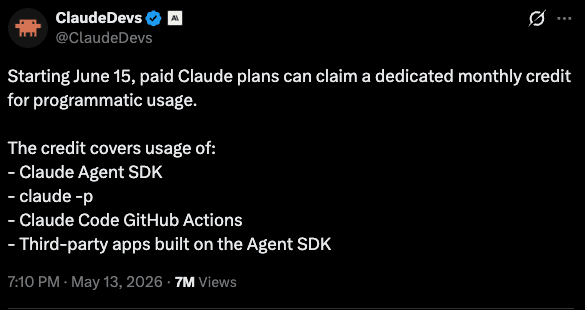
The new rules, short version:
- Anthropic's own UI (chat, Claude Code in terminal or desktop, Cowork). Covered by your subscription, same rate limits as before.
- Anything programmatic (Agent SDK,
claude -p, GitHub Actions, any third-party wrapper or harness built on the SDK). Still works with your subscription, but draws from a separate monthly credit equal to your subscription price ($20, $100, or $200), billed at full API rates, no rollover. - Direct API calls. Pay per token, as always.
The change goes live June 15, 2026.
What this actually costs you
The headline is "your subscription still covers third-party tools," but the credit numbers tell a different story. $200 of Sonnet at API rates is roughly 67M input tokens or 13M output tokens. A serious agentic session with multiple sub-agents and a 200K context window can chew through that in days, not a month. A single overnight AFK run on Opus can torch it in one shot.
Before, your Max 20x subscription was effectively an all you can eat buffet for any tool that could authenticate against it. After June 15, programmatic usage is a $200 a month tab at API prices, and when it's gone, your agents stop unless you explicitly enable "extra usage" billing on top.
This is going to hurt a lot of open-source projects. It's going to hurt mine. bide-code is built on top of T3 Code and exactly the kind of orchestration layer this change targets. AFK agentic coding in my view is the most productive way to ship software right now. This change makes that model dramatically more expensive for anyone who isn't running on Anthropic's own surfaces.
I get the economics. Flat-rate subscriptions can't subsidize unoptimized third-party token consumption forever, and the case for a separate billing axis for headless workloads is real. But framing this as "we're letting third-party tools back in" is generous. The honest version: programmatic usage is now metered at API rates inside your subscription, and the all-you-can-eat era is over.
If you've been building on a Claude subscription, audit your usage before June 15. Decide whether you're moving to a direct API key, leaning on extra usage billing, or rebuilding around tighter prompt caching and cheaper models. The flat-fee free ride is done.
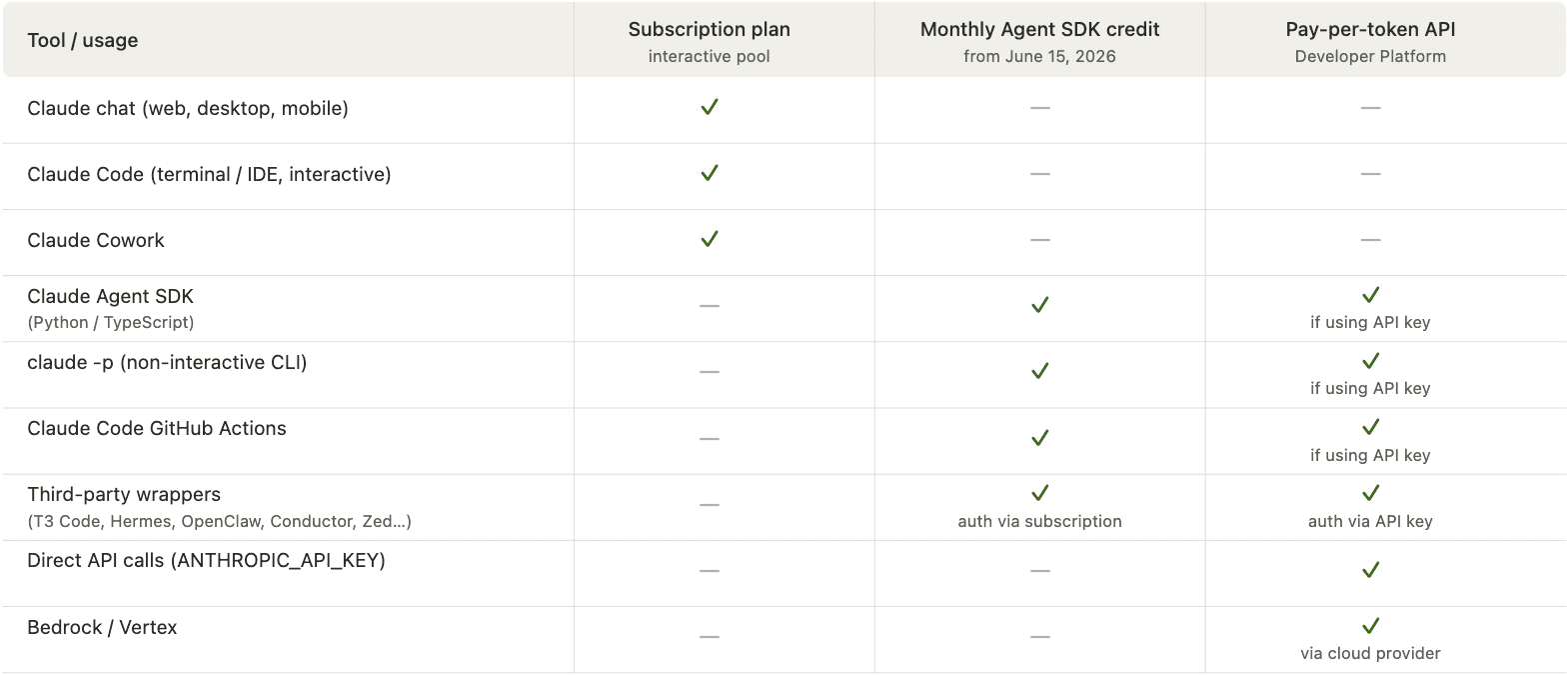
Here's the quick summary of what pricing you can use for specific tool:
Stay in the loop
Get the latest AI & tech insights delivered straight to your inbox.

Stay in the loop
Get the latest AI & tech insights delivered straight to your inbox.